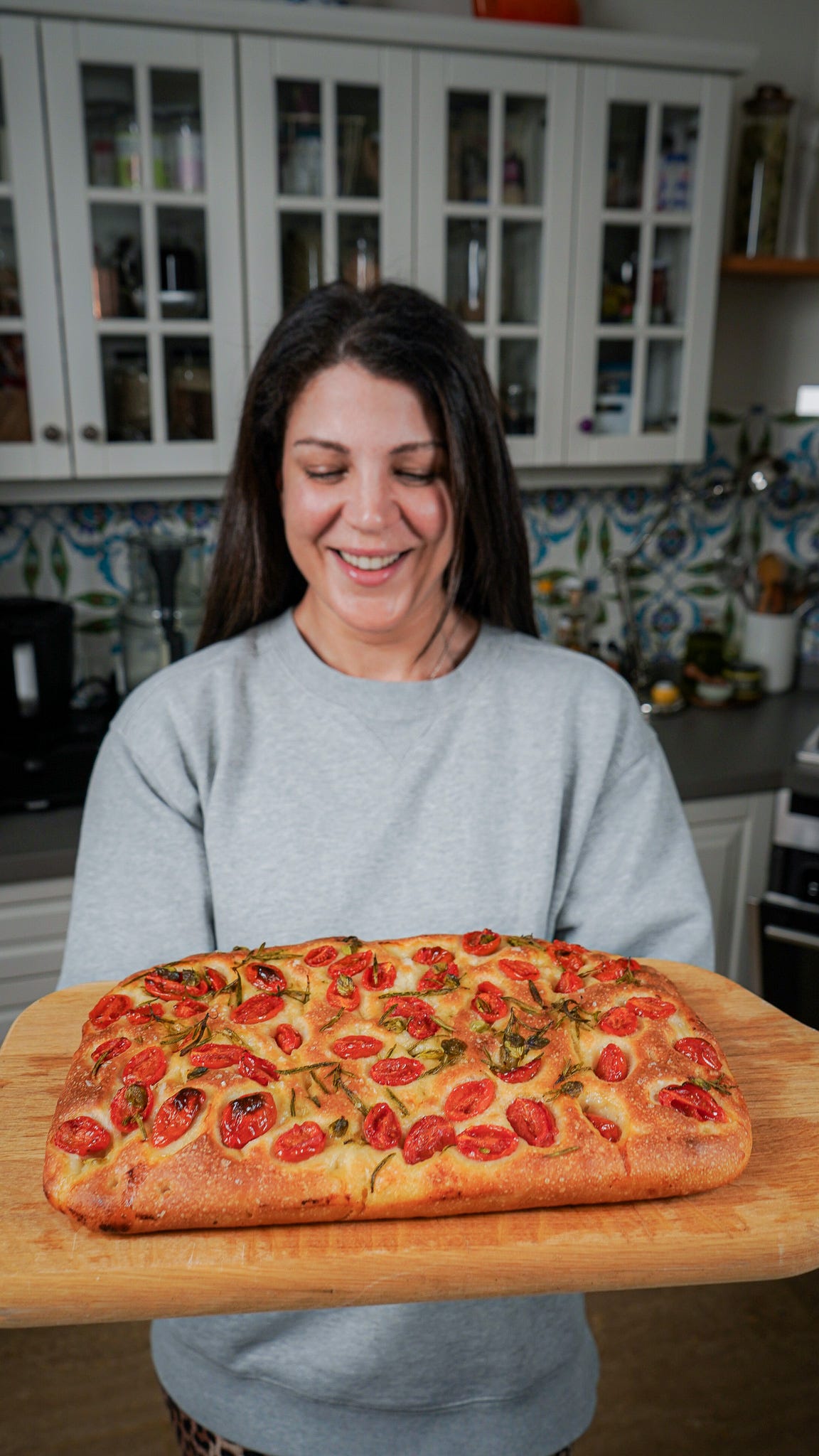
A good focaccia is really a question of olive oil. Some of it goes into the dough, a generous film goes under it in the tray, and the last of it goes over the top in a brine of oil and water that settles into the dimples and half fries the surface as it bakes. Salt, herbs and time do the rest.
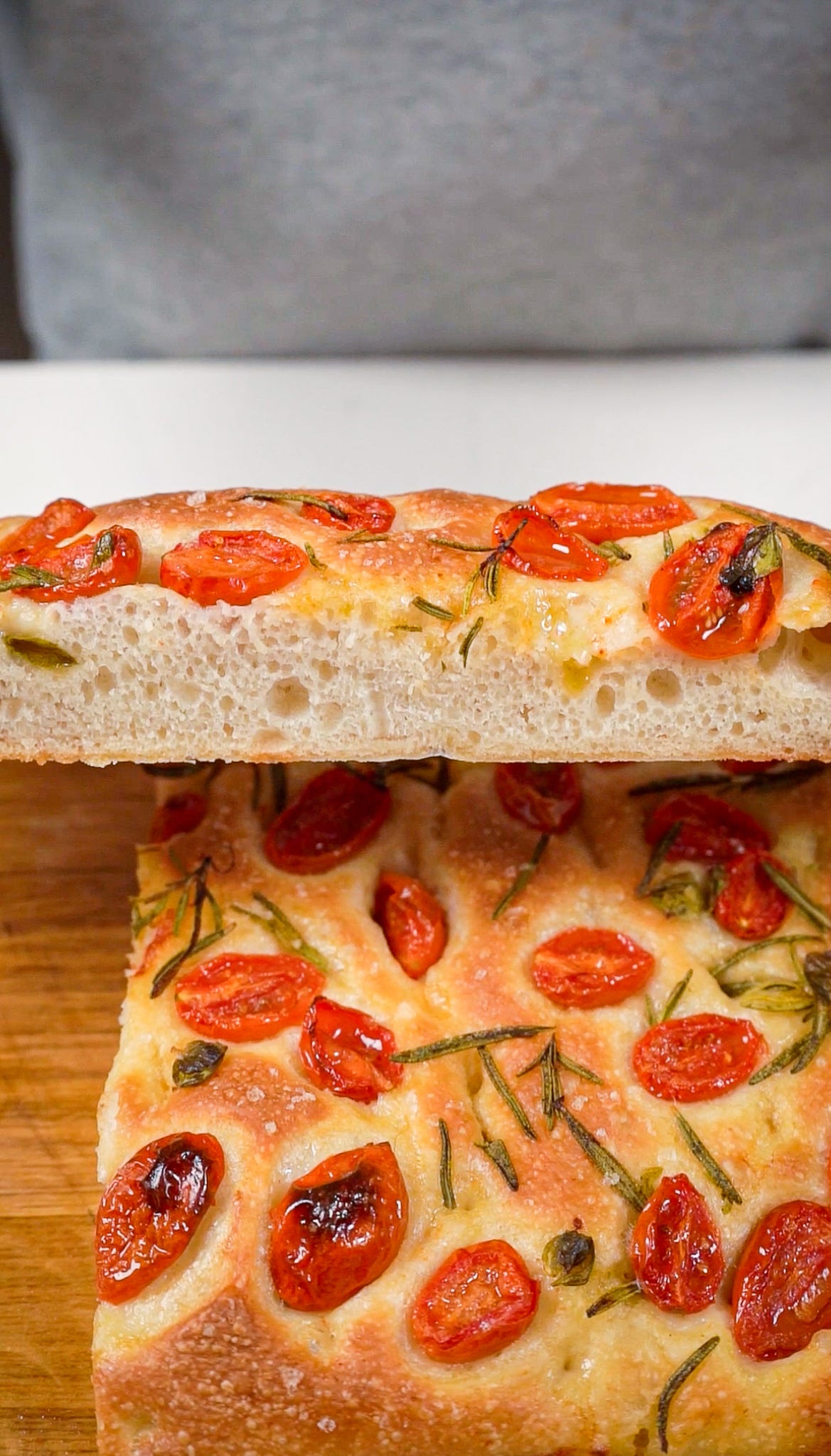
This one comes out thin and gold, crackling at the edges, tender through the middle, with a base you can hear against the knife. Cut into squares with tomatoes on top, split and filled for sandwiches, or eat it as is.
My friend Francesca, an Italian chef, shared this recipe with me after making it in a Michelin-starred kitchen in Malta. Like many professional recipes, it was written for three-kilo batches, stronger flour and commercial ovens. What follows is my home version, scaled to one tray and adapted in just two places.
The flour. The original assumes strong professional bread flour. The flour on most Turkish supermarket shelves is generally not too high in protein. So I wanted a recipe that works with what is actually on the shelf. Because stronger flour absorbs more water, I reduced the hydration from 80% to 74%, making it work with the bread flour most of us can easily find.
The time. Francesca’s version is a same day dough: three hours of folding and resting, then bake. I have kept that, and added a second route. If you have the time, the dough spends the night in the fridge instead, and comes out better for it. Both are below. Neither is the compromise.
Everything else is hers, including the detail that gives the recipe away: the water goes in cold, and in a hot kitchen, part of it goes in as ice. Cold water slows the dough from the first minute, which is the entire idea. There is very little yeast here, and almost no work. What looks like effort in a good focaccia is really just time.
Fold it, let it rest, and trust the process.
Francesca’s Focaccia
Yield: About 800 g dough, 4 to 6 servings
Time, same day version: About 20 minutes of work, then 3 hours of resting and folding, then baking.
Time, overnight version: Day one, 20 minutes of work and 2 hours of resting and folding, then overnight in the fridge. Day two, about 2 hours before it goes in the oven, almost all of it unattended.
INGREDIENTS:
For the dough
500 g bread flour, 11-12% protein
370 g cold water, part of it ice water if your kitchen is hot
12 g fine salt
25 g extra virgin olive oil
1 g instant dry yeast
For the tray and the top
30 to 40 g extra virgin olive oil, for the tray
20 g water, 20 g extra virgin olive oil and a good pinch of fine salt, whisked together
Flaky salt
Topping options:
Cherry tomatoes, halved
Tomatoes, sliced thin and patted dry
Courgette, sliced very thin
Olives, pressed into the dough
Fresh rosemary or thyme
Equipment
A digital scale
33 x 22.5 cm shallow tray
A stand mixer with a dough hook
A lidded container (roughly 2 litres)
A wire rack
A small bowl and a whisk or fork
A dough scraper
A serrated bread knife


METHOD
Put the flour and yeast in the bowl of a stand mixer fitted with the dough hook. Add the cold water and mix on the lowest speed for 3 to 5 minutes, until the dough comes together. It will look rough and shaggy. Do not try to make it smooth. Cover and rest 15 minutes.
Add the salt and mix on low for 3 minutes, until you cannot feel it in the dough. Add the olive oil in a slow stream, mixing on speed 2 for 4 to 5 minutes. Raise to speed 3 for 2 to 3 minutes more, until the dough turns smooth and starts gathering around the hook. It should pull away from the sides while still clinging to the bottom, and it will be very soft and tacky.
Oil a lidded container lightly, transfer the dough, cover, and leave it 30 minutes.
Fold, three times, 30 minutes apart. Wet your hands. Take one edge of the dough, lift it gently upward, and fold it over onto itself. Turn the container and repeat on all four sides. That is one fold. Cover, rest 30 minutes, then repeat, twice more.
The dough changes noticeably with each fold. After the first fold it is slack and formless. By the second it resists a little and holds its shape. By the third it is smooth, puffy and full of air.
For same day baking cover and leave the dough at room temperature for 1 more hour after the third fold. This is the original, and it makes an excellent focaccia.
If you have time, cover tightly and refrigerate 18 to 24 hours after the third fold. The next day, take the dough out and leave it at room temperature 30 to 45 minutes before going on.
Oil the tray generously, more than feels sensible.
Loosen the dough around the edges of the container, then tilt it and let the dough fall out under its own weight. Do not pull it. Guide it gently, preserving as much of the trapped air as possible.
Let it spread. Rest 15 minutes before you touch it, then ease it outward with oiled fingers toward the corners. If it resists, stop and give it another 10 minutes.
Cover and leave in the tray 45 to 60 minutes, until it looks puffy and soft and has reached the edges. Heat the oven to 220°C now and let it come fully up to temperature.
Whisk the water, olive oil and salt. Dip your fingertips in it and press straight down into the dough, all the way to the tray, making deep dimples across the whole surface. Then pour the rest over so it settles into the holes. Add your toppings and a little flaky salt, and rest 10 to 15 minutes before baking.
For courgette, toss the thin slices with a little olive oil and a pinch of salt, then lay them flat and slightly overlapping, pressing each into a dimple so it does not slide off in the oven.
For cherry tomatoes, set them cut side up and press until anchored. Scatter over herbs and a little flaky salt. Rest 10 to 15 minutes.
Bake 22 to 30 minutes at 220°C, until the top is deep gold and the underside is properly coloured. Lift a corner with a spatula and look. Pale underneath means it is not finished.
Slide the focaccia out of the tray and put it straight onto the oven rack, or onto a hot stone, for another 5 to 10 minutes. This is what makes the base crisp.
Cool on a wire rack, not in the tray, so the underside does not sit in its own steam. Rest a few minutes, then cut.
Kitchen Notes
Fermentation is driven by temperature, so in a cool kitchen every rise will take longer than the times given here. Judge the dough by it’s volume and by how it feels, not by the clock.
If you can get strong bread flour at 13 percent protein or above, use it, and try adding 20 to 30 g more water.
Best within a few hours, and still very good at room temperature later the same day, which makes it the right thing to take to a beach, picnic or a boat. Reheat leftovers for 5 minutes in a hot oven.